 Add to Chrome
 Add to Firefox
 Add to Edge
EasyVFX: Frequency-Driven Decoupling for Resource-Efficient VFX Generation
May 21, 2026
Generating high-fidelity visual effects (VFX) typically demands massive datasets and prohibitive computational power due to the intricate coupling of spatial textures and temporal dynamics. In this paper, we introduce EasyVFX, a resource-efficient framework that achieves realistic VFX synthesis under stringent constraints. Our core philosophy lies in frequency-domain decomposition: we observe that the complexity of VFX can be significantly mitigated by decoupling high-frequency components, which represent intricate spatial appearances, from low-frequency components that encapsulate global motion dynamics. This spectral disentanglement transforms a high-dimensional learning problem into manageable sub-tasks, thereby lowering the optimization barrier and reducing data dependency. Building upon this insight, we propose a two-stage training paradigm. First, we design a Frequency-aware Mixture-of-Experts (Freq-MoE) architecture. By utilizing a soft routing mechanism, our model assigns specialized experts to distinct spectral bands, enabling them to cultivate robust priors for appearance and motion dynamics. This specialization allows the model to acquire foundational VFX knowledge with fewer GPU resources. Second, we introduce a Test-Time Training strategy powered by a novel Frequency-constraint Loss. This allows the pre-trained model to swiftly adapt to specific, unseen effects through localized optimizations, requiring only about 100 steps on a single GPU. Experimental results demonstrate that EasyVFX produces structurally consistent and visually stunning effects, proving that frequency-aware learning is a key catalyst for democratizing professional-grade VFX.

InstanceAnimator: Multi-Instance Sketch Video Colorization
Mar 26, 2026We propose InstanceAnimator, a novel Diffusion Transformer framework for multi-instance sketch video colorization. Existing methods suffer from three core limitations: inflexible user control due to heavy reliance on single reference frames, poor instance controllability leading to misalignment in multi-character scenarios, and degraded detail fidelity in fine-grained regions. To address these challenges, we introduce three corresponding innovations. First, a Canvas Guidance Condition eliminates workflow fragmentation by allowing free placement of reference elements and background, enabling unprecedented user flexibility. Second, an Instance Matching Mechanism resolves misalignment by integrating instance features with the sketches, ensuring precise control over multiple characters. Third, an Adaptive Decoupled Control Module enhances detail fidelity by injecting semantic features from characters, backgrounds, and text conditions into the diffusion process. Extensive experiments demonstrate that InstanceAnimator achieves superior multi-instance colorization with enhanced user control, high visual quality, and strong instance consistency.
Follow-Your-Instruction: A Comprehensive MLLM Agent for World Data Synthesis
Aug 07, 2025With the growing demands of AI-generated content (AIGC), the need for high-quality, diverse, and scalable data has become increasingly crucial. However, collecting large-scale real-world data remains costly and time-consuming, hindering the development of downstream applications. While some works attempt to collect task-specific data via a rendering process, most approaches still rely on manual scene construction, limiting their scalability and accuracy. To address these challenges, we propose Follow-Your-Instruction, a Multimodal Large Language Model (MLLM)-driven framework for automatically synthesizing high-quality 2D, 3D, and 4D data. Our \textbf{Follow-Your-Instruction} first collects assets and their associated descriptions through multimodal inputs using the MLLM-Collector. Then it constructs 3D layouts, and leverages Vision-Language Models (VLMs) for semantic refinement through multi-view scenes with the MLLM-Generator and MLLM-Optimizer, respectively. Finally, it uses MLLM-Planner to generate temporally coherent future frames. We evaluate the quality of the generated data through comprehensive experiments on the 2D, 3D, and 4D generative tasks. The results show that our synthetic data significantly boosts the performance of existing baseline models, demonstrating Follow-Your-Instruction's potential as a scalable and effective data engine for generative intelligence.
Follow-Your-Creation: Empowering 4D Creation through Video Inpainting
Jun 05, 2025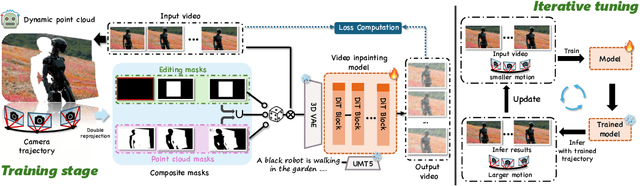
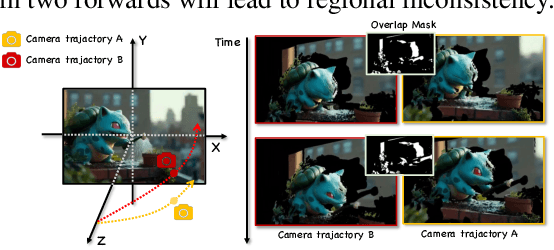
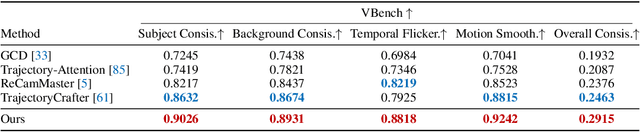
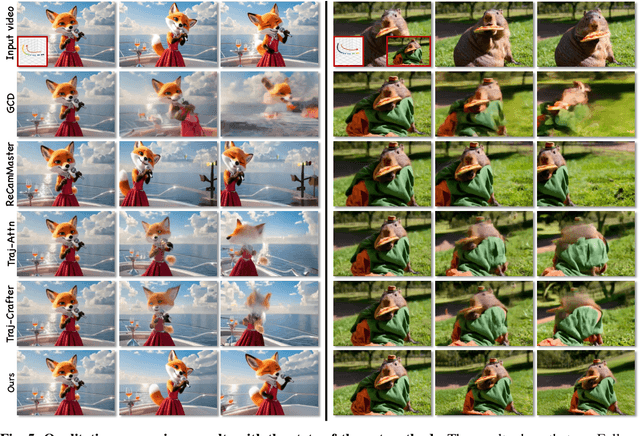
We introduce Follow-Your-Creation, a novel 4D video creation framework capable of both generating and editing 4D content from a single monocular video input. By leveraging a powerful video inpainting foundation model as a generative prior, we reformulate 4D video creation as a video inpainting task, enabling the model to fill in missing content caused by camera trajectory changes or user edits. To facilitate this, we generate composite masked inpainting video data to effectively fine-tune the model for 4D video generation. Given an input video and its associated camera trajectory, we first perform depth-based point cloud rendering to obtain invisibility masks that indicate the regions that should be completed. Simultaneously, editing masks are introduced to specify user-defined modifications, and these are combined with the invisibility masks to create a composite masks dataset. During training, we randomly sample different types of masks to construct diverse and challenging inpainting scenarios, enhancing the model's generalization and robustness in various 4D editing and generation tasks. To handle temporal consistency under large camera motion, we design a self-iterative tuning strategy that gradually increases the viewing angles during training, where the model is used to generate the next-stage training data after each fine-tuning iteration. Moreover, we introduce a temporal packaging module during inference to enhance generation quality. Our method effectively leverages the prior knowledge of the base model without degrading its original performance, enabling the generation of 4D videos with consistent multi-view coherence. In addition, our approach supports prompt-based content editing, demonstrating strong flexibility and significantly outperforming state-of-the-art methods in both quality and versatility.